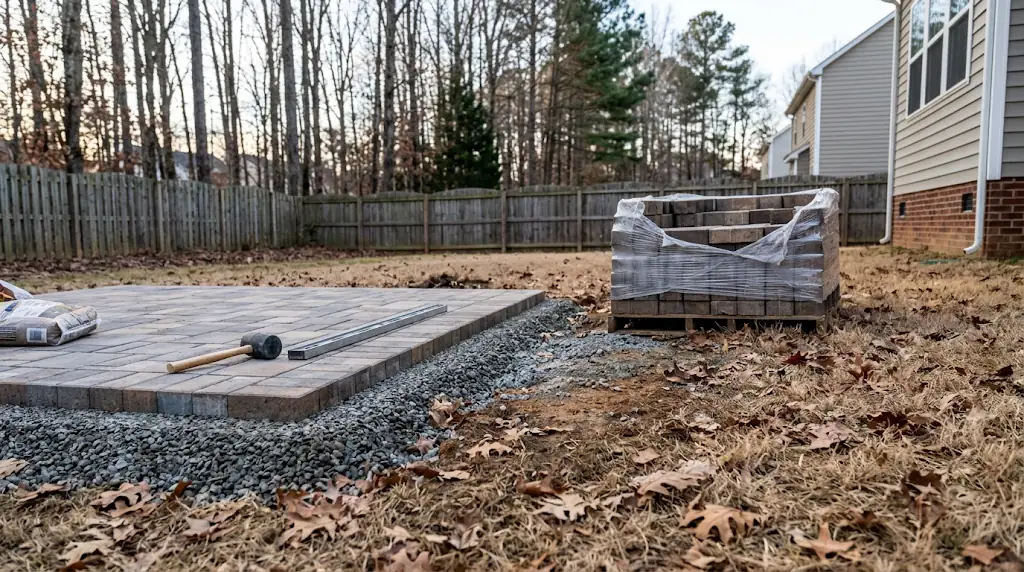
Late fall through early spring (October through March) is the best time of year to install a paver patio in Central North Carolina’s Triangle region. Mild Piedmont winters eliminate ground-freezing barriers found in northern climates, dormant lawns suffer minimal turf damage from heavy excavation machinery, and lower precipitation volatility prevents open-trench clay saturation common during humid summer thunderstorm cycles.
Season-by-Season Hardscape Feasibility in Central NC
While pavers can technically be installed year-round in Central North Carolina, each season introduces specific soil moisture, temperature, and scheduling trade-offs.
| Season | Months | Ground & Soil Conditions | Weather & Rain Factors | Polymeric Sand & Sealer Curing | Contractor Lead Time | Overall Rating |
| Late Fall | Oct – Nov | Optimal moisture; firm subgrade; minimal shrink-swell | Low precipitation; stable weather patterns | Ideal (Crisp air; 55°F–70°F cures polymers steadily) | 2 to 4 Weeks | Best Overall |
| Winter | Dec – Feb | Shallow frost line (<6″); clay easily excavated | Cold rain fronts; zero permanent ground freeze | Requires >32°F dry window for 24 hours | 1 to 3 Weeks (Fastest turnaround) | Excellent |
| Early Spring | Mar – Apr | Saturated soils from spring rains; heavy pollen | Frequent frontal rain systems; high pollen dust | Pollen can contaminate uncured joint sand | 6 to 10 Weeks (Peak backlog begins) | Good |
| Summer | May – Sep | Dry, hard surface clay; soft, saturated subsoil | Afternoon thunderstorms; 90°F+ heat; high humidity | Rapid moisture evaporation risks sand flash-drying | 8 to 12+ Weeks (Peak season waitlists) | Challenging |
Why Fall and Winter Outperform Summer in the Triangle
Unlike northern states where winter frost lines descend 36 to 48 inches below grade and freeze the soil solid for months, Central North Carolina operates in a temperate transition zone.
According to climate data from the North Carolina State Climate Office, the eastern Piedmont region averages winter highs in the low 50s and experiences an average frost depth of only 4 to 6 inches. The ground rarely freezes for more than 24 consecutive hours.
1. Native Red Clay Moisture Control
The single greatest challenge to hardscape structural integrity in Cary, Apex, and Morrisville is water in native Cecil clay loam. As documented in the NC State Extension Soils Guide, wet Piedmont clay transforms into a heavy, uncompactable slurry when exposed to standing water.
- Summer Thunderstorm Risks: Triangle summers regularly produce violent, localized pop-up thunderstorms that drop 1 to 2 inches of rain in under an hour. When an open excavation trench fills with water during base preparation, the underlying subgrade clay must dry out for days or be mechanically undercut and removed, driving up equipment and labor expenses.
- Winter Weather Stability: Winter precipitation in Central North Carolina typically arrives in steady, predictable frontal systems tracked days in advance. Between these systems, cool air and low solar heat prevent soil moisture volatility, allowing crews to dig, lay geotextile fabric, and compact aggregate without fighting flash mud conditions.
2. Protecting Turf and Landscaping
Transporting tons of crushed stone, bedding sand, and pavers requires mini-skid steers and motorized wheelbarrows.
- In the heat of July and August, warm-season grasses (Bermuda, Zoysia) and cool-season lawns (Tall Fescue) are under severe heat stress. Heavy machinery tracks crush and kill active root crowns, requiring costly aerating and sod repair.
- During the dormant window from November to March, turfgrass root systems are biologically inactive. Ground protection mats spread across dormant grass distribute equipment weight with minimal turf shear, allowing the lawn to bounce back naturally in April.
3. Curing Performance for Polymeric Joint Sand
Polymeric sand requires specific environmental conditions to activate, link its chemical polymers, and dry to full structural hardness:
- High summer surface temperatures—often exceeding 130°F on dark pavers—cause the activation water to flash-evaporate before it penetrates the full depth of the joint. This leaves the bottom half of the joint sand loose and powdery.
- High relative humidity above 80% during summer mornings slows down curing, leaving sand pliable and vulnerable to washouts.
- Fall and winter installations (above 40°F) provide controlled evaporation rates, ensuring water migrates completely through the joint profile to create a resilient, rubberized bond that repels weeds and resists erosion.
Critical Operational Thresholds for Cold-Weather Installations
Executing winter paver installations across Wake, Chatham, and Lee counties requires adherence to fundamental physical temperature thresholds:
- Excavation & Base Compaction: Can occur at any ambient temperature above 28°F, provided there is no ice or standing frost blanket on the clay subgrade. Compacted ABC crushed aggregate stone is completely immune to ambient cold.
- Bedding Sand Screeding: Setting sand must remain dry and unfrozen. Wet, frozen sand forms hard clumps that prevent pavers from seating evenly under mechanical plate compaction.
- Polymeric Sanding Window: Modern advanced polymeric sands (such as Alliance Gator Maxx G2 or Techniseal HP NextGel) require an ambient temperature of at least 32°F for a continuous 24- to 48-hour window without rain. If nighttime temperatures dip below freezing, joint sand application must wait for an afternoon warming window.
- Surface Sealing Thresholds: Solvent- and water-based protective sealers require minimum ambient temperatures of 50°F to 55°F to crosslink properly. Sealing projects scheduled in deep winter are best held until warm afternoon stretches or executed during the following spring.
The Contractor Scheduling Advantage: Avoiding the Spring Rush
Hardscape demand in Central North Carolina follows an aggressive seasonal spike:
- The Spring Bottleneck (March – June): Homeowners in planned developments across Apex (Bella Casa, Sweetwater), Cary (Preston, Amberly), and Holly Springs (12 Oaks) begin calling hardscape contractors simultaneously as soon as warm weather arrives. Contractors book their schedules 2 to 3 months out, material yards experience regional inventory shortages, and HOA Architectural Review Committees (ARCs) face processing backlogs.
- The Off-Peak Window (October – February): Scheduling your project in late fall or winter eliminates seasonal waitlists. Premium stone quarries maintain full stock, municipal permitting through the Town of Cary Residential Permitting or Wake County Permits and Inspections moves faster, and construction completes weeks before the spring outdoor entertainment season begins.
Winter-to-Spring Hardscape Planning Timeline
To have your outdoor living space ready for use by April 1, follow this structured schedule:
- November 1 – November 15: Secure preliminary property surveys, define patio dimensions, and request on-site contractor evaluations.
- November 15 – December 15: Submit scaled plans to your HOA Architectural Review Committee. Winter submissions bypass spring review backlogs and generally clear within 14 to 21 days.
- January – February: Break ground on excavation, install subsurface French drains or buried downspouts, compact the structural aggregate base, and set pavers.
- Late February – Mid-March: Apply polymeric joint sand during a clear 48-hour weather window, install low-voltage hardscape lighting, and complete edge mulch grading.
- April 1: Enjoy a cured, fully functional outdoor patio just as warm weather arrives.
Planning your hardscape project during the late fall or winter months secures the fastest turnaround times, optimal soil compaction conditions, and full enjoyment of your yard the moment warm Carolina weather returns. If you are considering a new paver patio, walkway, or pool deck in Cary, Apex, Morrisville, Holly Springs, Fuquay-Varina, Pittsboro, or Sanford, contact Cary Pavers through our contact page to arrange an on-site property evaluation and reserve your winter installation window.