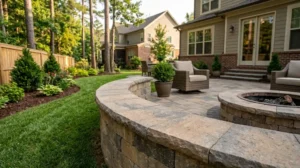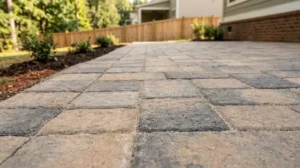
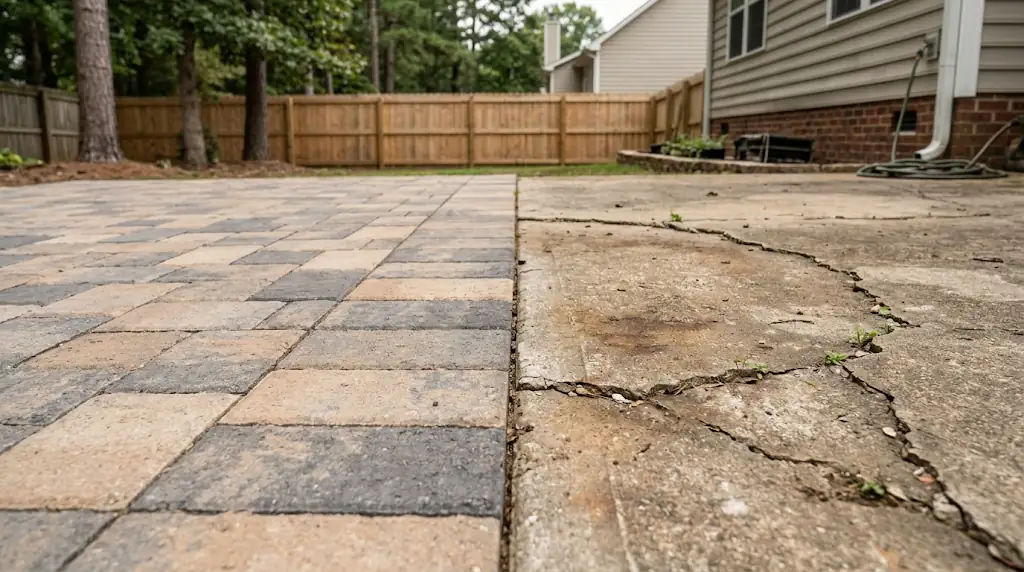
Interlocking paver patios significantly outperform poured and stamped concrete in Central North Carolina’s climate because segmented pavers flex independently across shifting Piedmont red clay without fracturing during seasonal shrink-swell and freeze-thaw cycles. While rigid concrete slabs inevitably crack under the Triangle’s extreme soil expansion, intense humidity, and 46-plus inches of annual rainfall, interlocking pavers provide superior compressive strength, seamless underground access, and permanent repairability.
Performance Comparison: Pavers vs. Concrete in Central NC
| Engineering / Performance Metric | Interlocking Concrete Pavers | Poured Concrete Slab (Broom Finish) | Stamped & Colored Concrete |
| Compressive Strength (PSI) | 8,000 to 10,000+ PSI | 3,000 to 4,000 PSI | 3,000 to 4,000 PSI |
| Flexibility / Soil Movement Tolerance | High (Segmented joints absorb subgrade shift) | Zero (Rigid monolith; cracks under tension) | Zero (Rigid monolith; cracks through patterns) |
| Piedmont Clay Shrink-Swell Resistance | High (Joints open/close microscopically) | Very Poor (Snaps across mid-span) | Very Poor (Uncontrolled surface fracture) |
| Freeze-Thaw Durability | Unaffected (Water drains through joints) | Moderate (Surface pitting and spalling) | Poor to Moderate (Sealer failure & flaking) |
| Wet Slip Resistance | High (Textured finish + sand friction) | Moderate (Broom finish provides traction) | Low (Slick acrylic sealers become ice-like) |
| Repairability | Seamless (Lift, level base, re-lay units) | Disfiguring (Patched cracks never match) | Permanent Scarring (Color matching impossible) |
| Expected Structural Lifespan | 30 to 50+ Years | 10 to 15 Years (Before structural cracking) | 8 to 12 Years (Before aesthetic degradation) |
| Average Installed Cost (Triangle) | $18 – $38 / sq. ft. | $8 – $14 / sq. ft. | $15 – $26 / sq. ft. |
Central North Carolina Climate Challenges on Hardscape Foundations
The Triangle environment presents specific microclimatic stresses that punish monolithic masonry surfaces. According to the North Carolina State Climate Office, the eastern Piedmont experiences wide seasonal moisture swings, average annual rainfall exceeding 46 inches, and substantial winter freeze-thaw oscillation.
1. Expansive Cecil Soil Movement
Central North Carolina is blanketed by heavy Cecil, Georgeville, and Appling clay series. As detailed in the NC State Extension Soils Guide, these subgrades contain fine-particle clays that expand dramatically when saturated by prolonged winter precipitation and shrink rapidly under 90°F+ summer droughts.
- A rigid 4-inch concrete slab lacks tensile flexibility. When the clay underneath heaves or contracts unevenly, the slab bridges empty voids, loses underlying support, and snaps along shear points.
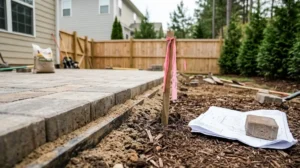
- Pavers are dry-laid on an engineered aggregate base. Because every unit is an isolated block cushioned by ASTM C33 sand and bounded by polymeric sand, the entire surface articulates with minor subgrade movement without fracturing.
2. Piedmont Freeze-Thaw Oscillation
Unlike northern states where the ground freezes solid in November and stays frozen until March, Central North Carolina cycles above and below the freezing point 30 to 40 times each winter.
- Temperatures in Cary, Apex, and Holly Springs routinely drop to 26°F at night and rise to 50°F the following afternoon.
- Trapped moisture beneath a rigid concrete slab freezes, expands by roughly 9% in volume, pushes upward against the slab bottom, and thaws within 12 hours. This cycling creates hydraulic pressure that shatters unreinforced poured concrete.
- Interlocking paver bases feature compacted ABC stone or open-graded crushed rock that provides a subterranean drainage channel, preventing trapped groundwater from accumulating directly beneath the surface.
3. High Humidity and Microbial Growth
Summers in Wake, Chatham, and Lee counties bring sustained humidity levels exceeding 70% to 80%.
- Poured concrete absorbs surface moisture and creates an alkaline breeding ground for black algae, green lichen, and mildew in shaded backyard lots across Morrisville, Pittsboro, and Sanford.
- Stamped concrete requires top-coat topical acrylic sealers to maintain color. In North Carolina’s high-humidity summers, moisture vapor rising from the clay becomes trapped beneath this impervious clear coat, turning the sealer cloudy white (blushing) and causing it to peel off in large flakes.
Structural Failure Mechanics: Why Poured Concrete Cracks
Poured concrete contractors cut expansion joints (control joints) into slabs, asserting they prevent cracking. In reality, control joints simply encourage the slab to crack inside a pre-cut groove. In Triangle backyards, concrete routinely bypasses control joints entirely.
Failure Vectors Common to Wake and Chatham County Backyards:
- Pine and Hardwood Root Intrusion: Fast-growing native trees such as Loblolly pines, sweetgums, and willow oaks send aggressive lateral feeder roots through the top 8 to 12 inches of soil searching for water. When a root contacts the underside of a poured slab, it levers the rigid stone upward, snapping it into multiple jagged pieces. With pavers, roots may displace three or four blocks, which can be lifted, cleared of roots, and reset in under two hours.
- Settlement Along House Foundations: Most new homes in planned communities throughout Cary, Apex, and Fuquay-Varina feature uncompacted backfill soil around foundation walls. Poured concrete poured against these foundations shears away and tilts back toward the home as the backfill settles, creating a code violation by directing rainwater directly into crawlspaces or foundation footings.
- Disfiguring Repairs: There is no structural method to fix cracked poured or stamped concrete without visible scarring. Injected epoxy, gray hydraulic cement, or resurfacing overlays leave obvious discoloration lines that degrade curb appeal and home appraisal values.
Traction, Safety, and Heat Retention Around Living Spaces
Central North Carolina outdoor living spaces center around swimming pools, grilling zones, and uncovered seating areas subjected to direct summer sun.
- Wet Traction: Stamped concrete relies on stamped patterns that mimic slate or stone, sealed with high-gloss solvent acrylics. When wet from lawn sprinklers, summer downpours, or pool splashing, stamped concrete turns exceptionally slick. Interlocking concrete pavers maintain natural surface friction without high-build topical coatings, providing high slip resistance under wet conditions.
- Surface Temperature: Dark-stained or stamped concrete absorbs solar radiation and retains intense surface heat. Standard light-to-medium-blend concrete pavers, permeable pavers, and light-colored porcelain hardscapes dissipate heat rapidly, remaining walkable during 95°F July afternoons in Apex and Cary.
The True Cost of Ownership: Upfront Savings vs. Lifecycle Value
Poured concrete carries a lower initial installation cost, but its lifecycle economics in Central North Carolina favor paver systems over a 15-year horizon.
Poured Concrete Lifecycle Timeline:
- Year 0: Installation cost: $4,000 for a 400-square-foot patio.
- Years 2–3: Hairline cracking emerges across control joints and corners.
- Years 4–5: Deep fractures appear; moss and dirt settle into cracks; pressure washing widens fissure gaps.
- Years 6–8: Differential settling creates trip hazards along patio borders.
- Years 10–12: Complete surface degradation requires full demolition, jackhammer removal, disposal fees ($2,500 to $4,000), and complete replacement.
Interlocking Paver Lifecycle Timeline:
- Year 0: Installation cost: $9,500 for a 400-square-foot patio.
- Years 3–5: Pressure wash and sweep in fresh polymeric sand ($150 DIY or $400 professional service).
- Year 10: Base remains structurally intact; pavers retain original compressive strength.
- Year 20+: Surface can be power-washed and sealed to look brand-new; any settled sections can be individually adjusted without replacing the surrounding field.
Impact on Triangle Resale Value
Real estate appraisals in Cary, Apex, and Morrisville consistently penalize cracked or failing concrete flatwork as deferred exterior maintenance. Prospective homebuyers in Wake and Chatham counties prioritize move-in-ready, high-end outdoor hardscapes. A clean, professionally installed interlocking paver patio returns 65% to 75% of its installed cost during home appraisals, while cracked, patched concrete often results in buyer repair credits during inspection negotiations.
When designing an outdoor living space built to withstand the demanding soil dynamics, heavy humidity, and freeze-thaw cycles of Cary, Apex, Morrisville, Holly Springs, Fuquay-Varina, Pittsboro, or Sanford, choosing pavers prevents the inevitable structural failure of poured concrete. Contact Cary Pavers via our contact page to schedule an on-site property consultation and design a lifetime hardscape built on an engineered aggregate foundation.