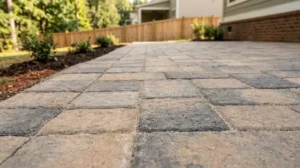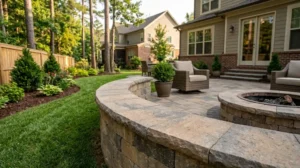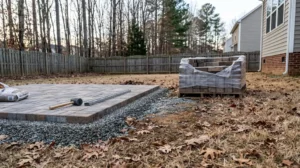
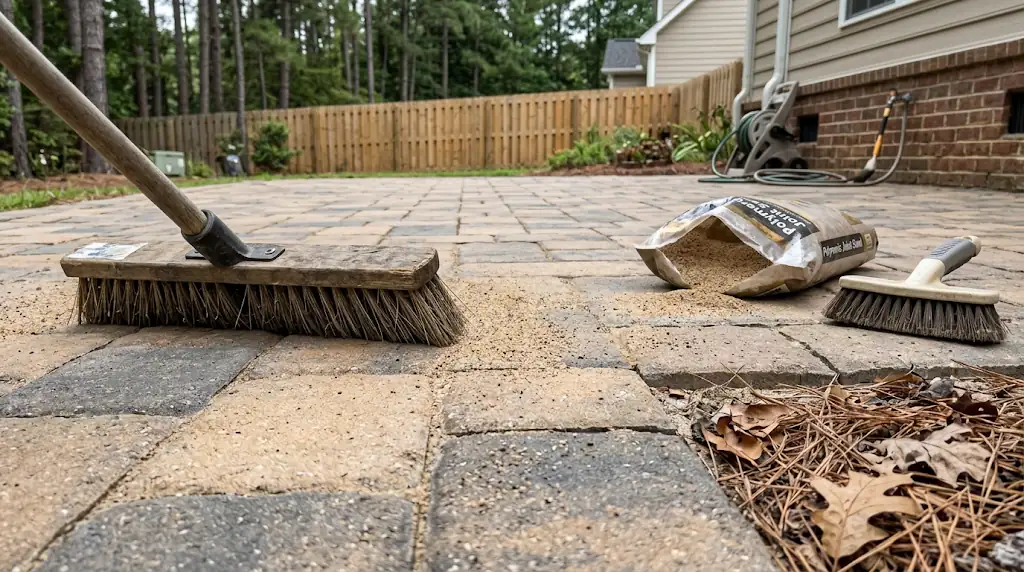
A professionally installed interlocking paver patio in Central North Carolina will last 30 to 50 years—and often outlive the home itself—because individual units do not crack under seasonal soil shifts. However, achieving this lifespan requires proactive joint maintenance every 3 to 7 years to combat the Triangle’s extreme humidity, heavy tree canopy organic debris, and repetitive winter freeze-thaw cycles.
Expected Lifespan Breakdown by Hardscape Component
While the concrete or natural stone units themselves are virtually permanent, a paver system consists of multiple layers that experience wear at different rates.
| Component | Expected Lifespan | Primary Degradation Factors in Central NC | Required Maintenance Action |
| Concrete Paver Units | 30 to 50+ Years | Heavy impact, acid exposure, unsealed salt corrosion | Occasional surface washing; individual unit replacement if stained |
| Natural Stone (Travertine/Bluestone) | 50 to 100+ Years | Acid rain etching, mineral spalling | Penetrating siloxane sealer reapplication every 3 to 5 years |
| Compacted Base (ABC Stone) | 50+ Years | Native red clay migration (if fabric was omitted), washouts | Inspect edge restraints annually; re-spike loose borders |
| Polymeric Joint Sand | 5 to 8 Years | Heavy rainfall erosion, power washing damage, pine pollen build-up | Strip and re-install polymeric sand when joints erode below ⅛” |
| Protective Surface Sealer | 2 to 4 Years | Intense summer UV radiation, high humidity, standing rainwater | Re-clean, degrease, and apply breathable penetrating sealer |
| Commercial Edge Restraints | 15 to 25 Years | Soil settlement, frost heaving, root pressure | Replace loose spikes with 10″ spiral steel nails; backfill soil |
The Central NC Environment: Why Hardscapes Degrade Without Maintenance
Maintaining pavers in Cary, Apex, or Pittsboro is fundamentally different from maintaining pavers in arid or northern climates. According to data from the North Carolina State Climate Office, the Triangle receives an average of 46 to 48 inches of rainfall per year, paired with sustained summer humidity levels exceeding 75%.
1. Pine Pollen, Tannin Staining, and Sweetgum Debris
The heavy canopy of Loblolly pines, sweetgums, and oaks across Wake and Chatham counties presents an ongoing threat to hardscape aesthetics:
- Pollen Accumulation: March and April bring heavy coatings of yellow pine pollen. If left unwashed, this organic dust settles into the polymeric sand joints, creating a nutrient-rich top layer that invites weed spores and moss to germinate.
- Tannin Leaching: Wet oak leaves and sweetgum seed pods left on unsealed pavers throughout wet winters leach natural tannic acid directly into the porous concrete surface, leaving deep brown and black silhouette stains that require specialized oxalic acid treatments to lift.
2. Black Algae (Gloeocapsa magma) and Green Moss
Due to Central NC’s shaded subdivisions and high relative humidity, North-facing and tree-covered patios quickly develop green moss in the joints and black cyanobacteria streaks across the paver faces.
- Moss roots expand inside joint spaces, dislodging sand particles and breaking the polymer bonds that hold the interlocking system rigid.
- Algae creates a slippery, hazardous film when wet, accelerating surface degradation by retaining surface moisture against the paver face.
3. Freeze-Thaw Joint Erosion
Central NC experiences roughly 30 to 40 freeze-thaw events each winter. When rainwater enters compromised joints and freezes, it expands by 9%, breaking degraded polymeric sand into fine, loose grains that wash away during heavy spring rains.
Routine Maintenance Schedule: Keeping Your Patio Pristine
Following a scheduled maintenance protocol prevents expensive repairs, joint failure, and weed infiltration.
Seasonal Tasks (Quarterly):
- Blowing / Sweeping (Bi-Weekly in Fall/Spring): Keep the surface free of organic debris, leaves, pine needles, and grass clippings. Use a standard leaf blower; never allow wet leaves to mat across paver joints.
- Garden Hose Rinse: Rinse away surface dust and pollen before it hardens. Avoid aiming high-pressure nozzles directly into the joint lines.
Annual Maintenance:
- Spot Weed and Algae Treatment: Treat minor joint weed growth or green mildew using an outdoor cleaner containing sodium hypochlorite or an eco-friendly quaternary ammonium wash. Allow the cleaner to dwell for 15 minutes, then agitate with a stiff nylon-bristle deck brush and rinse thoroughly. Never use metal wire brushes, as they scrape off the paver’s textured aggregate layer and leave behind iron fragments that rust.
- Edge Inspection: Inspect the outer perimeter borders. Confirm that mulch beds or turf backfill haven’t washed away from the commercial plastic or concrete edge restraints. Re-drive any loose 10-inch steel spikes that have backed out due to clay expansion.
Multi-Year Restorations (Every 3 to 5 Years):
- Deep Rotary Surface Cleaning: Clean the patio using a professional walk-behind rotary surface cleaner pressurized to roughly 2,000 to 2,500 PSI. This provides uniform cleaning without leaving the zebra striping common with standard pressure-washer wands.
- Joint Sand Replacement: If the existing joint sand has eroded more than ¼ inch below the paver chamfer (beveled edge), wash out the compromised sand and install fresh, high-performance polymeric sand.
- Surface Resealing: Apply a breathable, solvent-based or water-based penetrating sealer (semi-gloss or natural matte). Sealers protect pavers from oil stains, prevent UV color fading, lock in joint sand, and block weed growth.
Step-by-Step Guide: How to Properly Re-Sand and Seal a Paver Patio
Executing multi-year restoration correctly ensures the new joint sand lasts up to a decade without washing out:
[ Step 1: Pressure Clean Surface & Strip Degraded Sand (Down 1"+) ]
                              │
[ Step 2: Allow Subbase & Surface to Dry Completely (24-48 Hours) ]
                              │
[ Step 3: Sweep Premium Polymeric Sand at 45° Angle Into All Joints ]
                              │
[ Step 4: Mechanically Vibrate / Compact Sand to Eliminate Air Voids ]
                              │
[ Step 5: Leaf Blow Excess Dust from Surfaces & Recesses Below Chamfer ]
                              │
[ Step 6: Multi-Stage Water Mist Activation (Followed by 24h Dry Cure) ]
                              │
[ Step 7: Apply Breathable Penetrating Joint-Stabilizing Sealer ]
- Strip Old Sand: Use a zero-degree turbo nozzle to blast out failing joint sand, moss, and root structures to a minimum depth of 1 inch (or half the paver’s thickness).
- Mandatory 48-Hour Dry Window: Never sweep polymeric sand into damp joints. Wait 24 to 48 hours of clear weather until the pavers and underlying bedding layer are dry. Trapped moisture triggers the polymers prematurely, causing white hazing on the paver surface.
- Sweep and Consolidate: Spread high-performance polymeric sand across the patio. Sweep it diagonally across the joint lines to fill the voids completely.
- Mechanical Compaction: Run a vibrating plate compactor fitted with a protective rubber pad (or firmly tap the field with a rubber mallet and two-by-four) over the patio. Vibration settles the sand, removes hidden air voids, and drops the sand level. Re-sweep to fill remaining voids up to ⅛ inch below the paver chamfer.
- Thorough Blow-Off: Use a leaf blower on low throttle to remove every trace of sand dust from the paver faces, beveled edges, and texture pits before wetting. Any sand left on top will glue permanently to the face of the paver.
- Water Activation: Mist the surface using a garden hose nozzle set to “shower.” Soak the joints in three gentle passes spaced 3 to 5 minutes apart to ensure water penetrates the full depth of the sand without washing it out of the joints.
- Allow 24 Hours to Cure: Keep all foot traffic off the patio for 24 hours (and vehicle traffic off driveways for 72 hours) to allow the polymers to dry and reach full compressive strength.
- Seal the Surface: Once the joints are fully cured, spray or roll a breathable penetrating sealer to lock the sand into an erosion-proof barrier.
What NOT to Do: Common Maintenance Mistakes in Central NC
- Do Not Blast Joints with Maximum Pressure: Using a 4,000 PSI pressure washer tip directly into paver joints strips out the structural sand, blows apart the bedding layer underneath, and causes the surrounding pavers to wobble and sink.
- Never Use Rock Salt (Sodium Chloride) for Winter Ice: Rock salt chemically attacks concrete pores, leading to surface spalling, pitting, and aggregate exposure during winter freezes. Use calcium magnesium acetate (CMA) or plain sand for winter traction.
- Avoid Non-Breathable Acrylic Film Sealers: High-gloss, film-forming sealers trap rising groundwater vapor drawn up from damp Piedmont clay. Trapped vapor creates a milky, opaque white blush beneath the film that cannot be washed away and requires costly chemical stripping.
A well-maintained paver patio adds lasting structural equity and outdoor enjoyment to homes across Wake, Chatham, and Lee counties. If your patio in Cary, Apex, Morrisville, Holly Springs, Fuquay-Varina, Pittsboro, or Sanford needs professional pressure washing, polymeric re-sanding, or protective sealing, contact Cary Pavers through our contact page to schedule a comprehensive hardscape restoration assessment.