Professional paver installation fixes yard drainage and eliminates standing water across the Triangle by replacing dense, non-absorbent Piedmont clay with subterranean open-graded aggregate reservoirs, permeable interlocking concrete pavers (PICP), and integrated subsurface French drains. By engineering the hardscape’s base to absorb, store, and redirect stormwater runoff away from home foundations, property owners convert problematic swampy turf into functional outdoor living spaces that comply with municipal impervious surface limits.
How Traditional Hardscaping vs. Permeable Pavers Handle Triangle Stormwater
When heavy summer cloudbursts or tropical storm remnants hit Central North Carolina, standard turf on compacted clay quickly saturates, leaving standing water for days.
| Drainage Parameter | Standard Solid Poured Concrete | Traditional Sand-Set Pavers | Permeable Interlocking Concrete Pavers (PICP) |
| Surface Infiltration Rate | 0% (100% runoff to lawn/gutters) | 0% to 5% (Nearly all runoff via slope) | Up to 100% (Over 500 inches/hour capacity) |
| Impervious Surface Status | 100% Impervious | 100% Impervious in Cary/Morrisville | Eligible for partial or full pervious credit |
| Subbase Stone Structure | None (Poured directly on subgrade) | Dense-graded crusher run (ABC stone) | Open-graded aggregate reservoir (No. 57 & No. 2) |
| Water Storage Capacity | 0 Gallons | Minimal lateral drainage | Subsurface retention zone (30% to 40% void space) |
| Erosion / Mud Prevention | Channels water to perimeter edges | Directs runoff along surface pitch | Eliminates surface pooling and soil erosion |
| Puddle Elimination Speed | Requires surface evaporation | Requires surface slope to perimeter | Immediate (Gravity-fed into subterranean base) |
The Science Behind Triangle Drainage Problems: Piedmont Red Clay
Central North Carolina experiences an average of 46 to 48 inches of annual rainfall, according to climate records from the North Carolina State Climate Office. Most subdivisions in Cary, Apex, Holly Springs, and Morrisville sit atop heavy Cecil and Georgeville soil series.
As outlined in the NC State Extension Soils Guide, these native clay soils have exceptionally slow percolation rates—often less than 0.05 to 0.2 inches of water absorption per hour. When builders grade suburban lots, heavy earthmoving equipment strips topsoil and shears the underlying clay into an impenetrable pan. Rainwater cannot infiltrate the earth, resulting in prolonged surface ponding, mosquito breeding zones, flooded crawlspaces, and foundation settling.
3 Ways Paver Systems Solve Yard Water Accumulation
[ Finished Surface: Permeable Pavers ]
                  │
[ Bedding Layer: 2" of ASTM No. 8 or No. 89 Stone ]
                  │
[ Base Reservoir: 4" of ASTM No. 57 Clean Crushed Stone ]
                  │
[ Subbase Reservoir: 6"+ of ASTM No. 2 Ballast Stone (30-40% Void Space) ]
                  │
[ Geotextile Separation Fabric & Perforated Collector Pipes ]
                  │
[ Compacted Piedmont Clay Subgrade (Sloped to Pop-Up Emitter / Swale) ]
1. Installing Permeable Interlocking Concrete Pavers (PICP)
Unlike standard pavers installed with fine bedding sand and tightly closed joints, permeable paver systems feature wider, engineered joints filled with small, angular clean chip stone (ASTM No. 8 or No. 89 aggregate).
- The Infiltration Mechanics: Rainwater flows directly through the wide stone joints into a subterranean aggregate subbase rather than washing across the patio toward the lawn or siding.
- The Aggregate Water Reservoir: Beneath the pavers lies an open-graded stone foundation consisting of 4 inches of ASTM No. 57 clean crushed granite and 6 or more inches of ASTM No. 2 ballast stone. This washed, angular stone contains no stone dust or fines, leaving roughly 30% to 40% open void space between the rocks.
- Temporary Detention: This empty void space functions as a subterranean cistern during heavy downpours. It captures thousands of gallons of surface water, holds it safely beneath the patio, and slowly releases it into the deeper subsoil or municipal stormwater channels without creating surface flooding.
2. Integrating Subsurface Downspout Piping and French Drains
Roof gutters dump an immense volume of concentrated water directly beside home foundations. A 1,500-square-foot roof section produces nearly 1,000 gallons of stormwater during a single 1-inch rainfall event.
- Dedicated Downspout Burial: Hardscape installation provides the ideal opportunity to capture and bury roof downspouts before subgrade compaction. Roof runoff should never be allowed to drain across a paver patio or empty directly against its structural retaining edges.
- Rigid PVC vs. Corrugated Pipe: Contractors must use smooth-wall Schedule 40 or thin-wall SDR-35 PVC pipe sloped at a minimum of 1% (1/8-inch per linear foot). Flimsy corrugated black pipe easily crushes under lawn traffic and traps debris in its internal ridges, leading to root clogs.
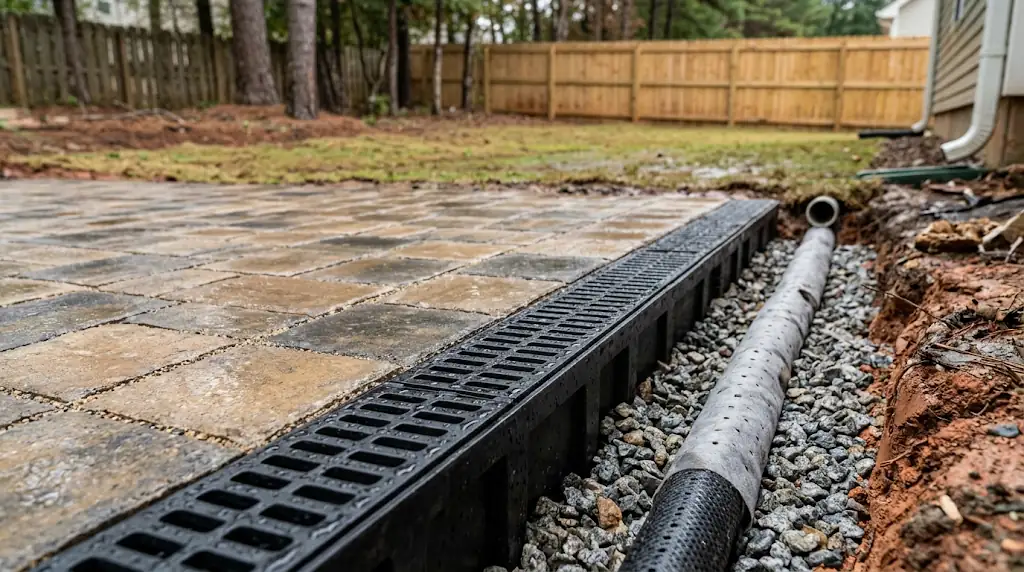
- French Drain Interceptors: For yards in hilly areas like Pittsboro, Fuquay-Varina, or Sanford where water rolls downhill from adjoining properties, a perimeter French drain (perforated PVC wrapped in geotextile sock and surrounded by No. 57 stone) is installed along the patio’s uphill edge to catch sheet runoff before it saturates the hardscape foundation.
3. Strategic Surface Grading and Swale Redirection
Every standard sand-set paver patio must be engineered with a positive shedding slope:
- The 1-Inch to 4-Foot Rule: Patios require a slope of 1.5% to 2% (a drop of 1/8 to 1/4 inch per linear foot) away from the house foundation toward designated drainage swales or vegetated buffers.
- Trench Drains and Catch Basins: Where lot topography slopes toward the home or matches an existing door threshold, a linear channel or trench drain with a decorative bronze or cast-iron grate must be embedded flush between paver courses. These drains capture high-velocity water and route it through buried PVC out to the street gutter, pop-up emitters, or an approved retention area.
Navigating Local Impervious Surface Caps and Drainage Laws
Drainage management in the Triangle is governed by both structural physics and regional zoning statutes:
- Town of Cary & Morrisville Impervious Limits: The Town of Cary Stormwater Guidelines enforce strict lot coverage maximums to limit runoff into surrounding watersheds like the Swift Creek and Jordan Lake reservoirs. Standard concrete patios count as 100% impervious. Installing an engineered permeable interlocking concrete paver (PICP) system allows homeowners to expand their outdoor living footprint while remaining within allowable zoning limits.
- North Carolina Surface Water Drainage Rule: North Carolina follows the “Modified Civil Law Rule” regarding surface water. Under state law, property owners cannot artificially alter the natural flow of surface water in a way that unreasonably channels or concentrates runoff onto an adjoining downhill neighbor’s land. Professional hardscape designs ensure stormwater discharge terminates in dedicated swales, detention zones, or legal stormwater easements.
Step-by-Step Drainage Verification Checklist
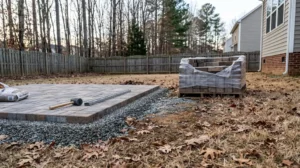
- [ ] Soil Excavation: Excavate native clay down 10 to 14 inches for permeable systems; strip all organic matter.
- [ ] Geotextile Liner: Line the excavation trench with a commercial non-woven geotextile fabric (Class 1 or 2) to prevent clay from mixing into the clean stone base.
- [ ] Subbase Reservoir Layer: Install 6+ inches of ASTM No. 2 stone; compact thoroughly with an 8,000+ lb force plate compactor.
- [ ] Choker Course: Lay 4 inches of ASTM No. 57 crushed angular granite; screed smooth and level.
- [ ] Bedding Layer: Apply 2 inches of ASTM No. 8 clean aggregate (do not use concrete sand on permeable setups).
- [ ] Joint Material: Fill paver gaps with ASTM No. 8 or No. 89 chips—never fine sand, which clogs drainage voids.
- [ ] Perimeter Overflow: Install a perforated collector pipe at the bottom edge of the stone reservoir routed to daylight or an exterior pop-up emitter for high-volume 50-year storm events.
Long-Term Maintenance: Keeping Your Drainage System Free of Clogs
Permeable pavers require minor annual upkeep to ensure fine organic matter, pollen, and pine needles do not settle into stone joints and choke water infiltration:
- Seasonal Sweeping: Sweep away fallen leaves, pine straw, and sweetgum seed pods each autumn before they decompose into organic silt.
- Vacuum Sweeping: Every 3 to 5 years, run a specialized regenerative air vacuum or dry pressure-wash the joints to extract clogged surface aggregate, then sweep fresh ASTM No. 89 stone chips into the joints to restore 100% infiltration capacity.
Transforming swampy, flood-prone clay soil into a dry, usable outdoor entertainment space requires proper hydraulic grading, heavy-duty aggregate excavation, and permeable hardscape engineering. If you are dealing with chronic standing water or challenging yard slopes in Cary, Apex, Morrisville, Holly Springs, Fuquay-Varina, Pittsboro, or Sanford, contact Cary Pavers via our contact page to schedule a comprehensive on-site drainage and paver design evaluation.