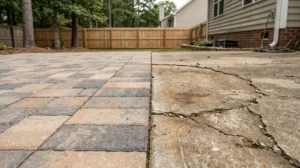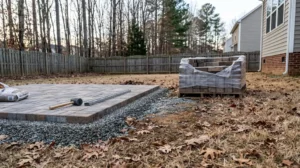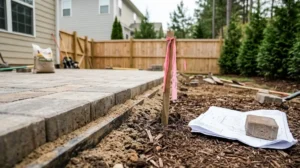
Installing pavers directly over North Carolina’s dense, expansive red clay will always cause them to shift, sink, and separate within two to three seasons unless the clay is excavated and replaced with a multi-layered, compacted stone base separated by a geotextile fabric. The high shrink-swell cycle of Piedmont clay means that successful, permanent paver installation requires digging a minimum of 7 to 9 inches deep and establishing structural drainage.
The Physics of North Carolina Red Clay and Why It Shifts Pavers
The native subgrade across Cary, Apex, Holly Springs, and the broader Triangle consists heavily of Cecil and Georgeville clay loams. As noted in the NC State Extension Soils Guide, these clay soils have a high “shrink-swell” potential.
- Water Retention: Clay acts like a sponge. During wet seasons (particularly our heavy winter and spring rains), clay absorbs massive amounts of water, causing it to expand and push upward.
- Dry Contraction: In hot, dry North Carolina summers, this same clay loses its moisture, shrinks, and forms deep cracks.
- Subduction: When pavers are placed directly on top of clay—or on a base that is too thin—this constant movement forces the heavy pavers to tilt, sink into the softened earth, and separate. High-traffic areas and edge lines fail first as the loose clay subgrade yields under foot traffic and outdoor furniture.
Step-by-Step Base Preparation Process to Prevent Shifting
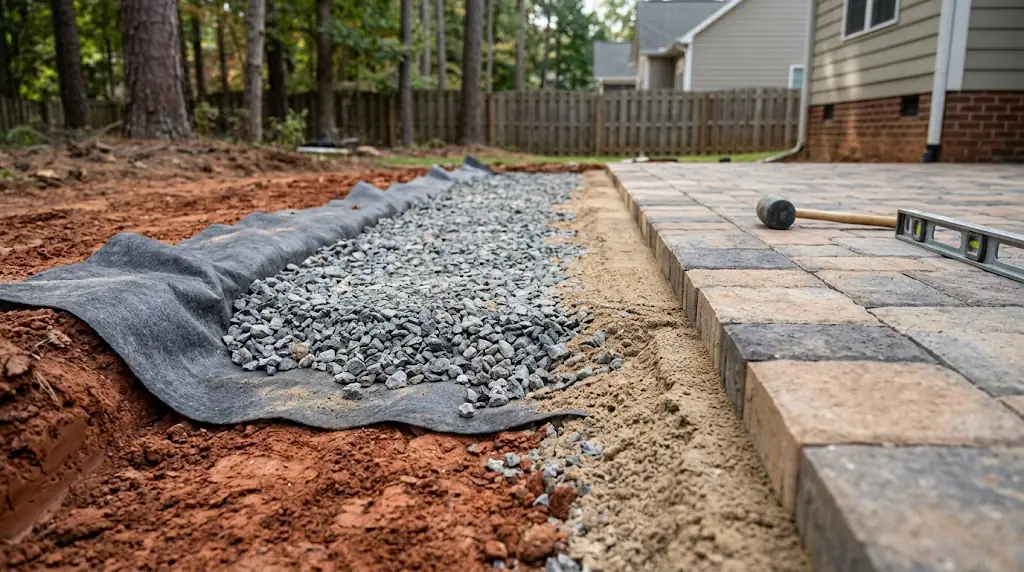
To defy the movement of Piedmont red clay, you must construct a layered, load-distributing foundation that keeps the pavers entirely separate from the shifting subgrade.
| Layer Name | Required Material | Thickness | Purpose on Clay Subgrade |
| Subgrade (Soil) | Native red clay (compacted) | Base level | Must be mechanically compacted to 95% Standard Proctor density before adding stone. |
| Barrier Layer | Non-woven geotextile fabric (4 oz+) | Paper-thin | Prevents dense clay from migrating upward and prevents aggregate from sinking. |
| Structural Base | Crusher run (ABC / ¾-inch minus stone) | 4 to 6 inches | Provides load-bearing strength and allows lateral water drainage. |
| Bedding Layer | Coarse, washed concrete sand (ASTM C33) | 1 inch | Creates a perfectly level, setting bed for the individual paver units. |
| Wear Layer | Concrete, natural, or porcelain pavers | Varies (typically 2⅜”) | The finished, visible pedestrian or vehicular surface. |
| Joint Stabilizer | Polymeric sand | Fill joints | Locks the pavers together horizontally; resists erosion and weed growth. |
The Three Most Critical Defenses Against Clay Movement
1. Always Install a Non-Woven Geotextile Fabric
Placing gravel directly onto wet NC clay is a guarantee of future failure. Over time, the heavy, wet clay will slowly work its way upward into the loose aggregate, while the heavy stone is pushed downward by gravity and usage.
Installing a heavy-duty, non-woven geotextile separation fabric directly over the excavated and compacted clay acts as a permanent barrier. It lets water pass through naturally while keeping the soil and your expensive stone base completely separate, preserving the integrity of the base.
2. Compaction in 2-to-3-Inch “Lifts”
Using a plate compactor on 6 inches of loose stone all at once will only compact the top 2 inches, leaving the bottom 4 inches loose and prone to settling.
- You must add the crusher run (often called “ABC” or crush-and-run) in 2-to-3-inch layers, known as lifts.
- Each lift must be thoroughly compacted using a commercial-grade vibrating plate compactor or a tamping rammer (“jumping jack”) on the clay subgrade itself.
- Moisten the stone slightly before compacting; this helps the angular particles lock together tightly.
3. Pitch and Manage Regional Drainage
Water is the natural enemy of any clay foundation. A flat patio built on clay will pool water underneath, softening the subgrade and accelerating shifting.
- The 1% to 2% Slope Rule: The entire base must be graded to slope away from home foundations and toward natural runoff zones, dropping at least 1 inch for every 4 to 8 feet of length.
- Sub-Base Drainage: For patios at the bottom of sloping yards in hilly areas like Pittsboro or Fuquay-Varina, a buried French drain or a perforated pipe must be installed along the uphill edge of the excavation. This redirects subsurface water before it can saturate the clay beneath the patio.
Understanding Permeable vs. Standard Base Systems in Central NC
For properties with severe drainage issues or strict local lot-coverage rules, choosing between standard sand-set bases and permeable systems is key to long-term success.
- Standard Aggregate Base (Sand-Set): Uses crushed stone (ABC) with fine particles to create a dense, shedding foundation. Ideal for most residential patios, provided it has a proper slope and the borders are anchored with heavy-duty edge restraints spiked into the aggregate.
- Permeable Aggregate Base (Open-Graded): Eliminates sand and fine particles entirely, using open-graded, angular stones (such as No. 57 and No. 8 crushed stone). According to stormwater management standards in communities like Cary and Apex, this allows rainwater to drain directly through the patio joints and back into the ground, reducing runoff and bypasses many impervious surface limits. Permeable installations require deeper excavation (often 10 to 12 inches) to handle the multi-tiered open stone.
Sizing and Excavation Requirements
The depth of excavation is the single most important variable in ensuring a patio never shifts. For a standard pedestrian paver patio, the excavation must account for:
- Paver Thickness: ~2⅜ inches (60mm)
- Bedding Sand: 1 inch (exact)
- Compacted Stone Base: 4 to 6 inches (depending on soil moisture)
- Total Excavation Depth: 7⅜ to 9⅜ inches
For vehicular driveway applications, the stone base must be doubled to 8 to 10 inches, resulting in an excavation depth of 11 to 13 inches to withstand the heavy loads on clay.
What Happens if Shortcuts Are Taken?
- Using Too Much Bedding Sand: Sand should never exceed 1 inch in thickness. Over-applying sand to level out an uneven, poorly excavated base is a common error. This extra sand will wash away, erode, and cause the pavers to sag and dip.
- Skipping Edge Restraints: Without rigid edge restraints (such as heavily spiked plastic or concrete borders), the natural expansion of the clay and outward pressure will push the perimeter pavers outward, causing the joints to open up and the entire system to unravel.
- Omission of Polymeric Sand: Cheap joint sand will wash out during North Carolina’s heavy downpours, allowing water to saturate the base and encouraging weeds and pests to move in. High-quality polymeric sand reacts with water to form an elastic, erosion-resistant bond.
To ensure your outdoor living space can withstand the intense shrink-swell cycles of Piedmont clay, work with a hardscape crew that has deep experience with local soil conditions. Contact Cary Pavers through our contact page to schedule an on-site soil evaluation and get a customized, high-performance patio plan.